University celebrates official reopening of historic Old Choral Hall
5 December 2025
One of the city’s most significant heritage buildings, Old Choral Hall, has been officially reopened on the University's City Campus following an extensive restoration and refurbishment.

Waipapa Taumata Rau, University of Auckland has celebrated the reopening of Old Choral Hall, one of the city’s most significant heritage buildings.
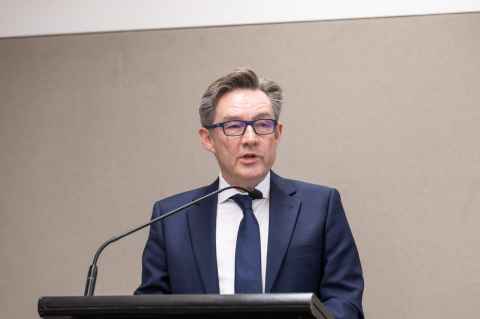
Following an extensive restoration and refurbishment project, a reopening ceremony was held at the Category 1 heritage building on 5 December. It included the unveiling of a commemorative plaque by Vice-Chancellor Professor Dawn Freshwater and the Minister for Arts, Culture and Heritage, Hon Paul Goldsmith, who is an alumnus of the University, as were his father and grandfather. Minister Goldsmith’s son Oliver also graduated last year with an MBChB.
The minister, who has an MA in history, quipped he wasn’t an example of the most economically beneficial student to a university when he took one of his papers.
“I did stage-three Akkadian language out the back of Old Choral Hall. There were three of us in the course, including now-Professor Tracey McIntosh. We translated Hammurabi’s law code. That’s my recollection of this space,” he said to laughter, adding, “It was a bit of a dump.”
Goldsmith said it was great to see Old Choral Hall’s transformation.
“Buildings matter, as do the environments that inspire their students to excellence.”
Also speaking at the reopening, Vice-Chancellor Professor Dawn Freshwater noted the project’s focus on sustainability, which was also central to the refurbishment of the Arts and Education Building B201, and new build, the Hiwa Recreation Centre.
“This reopening marks a major milestone in the broader programme of campus upgrades, reinforcing that commitment to sustainability, to heritage preservation and world-class learning environments to create a ‘sticky' campus,” she said. “Many of the city's iconic buildings are on this campus, including Old Government House and its gardens, and we should be very proud of them.”





This reopening marks a major milestone in the broader programme of campus upgrades, reinforcing that commitment to sustainability, to heritage preservation and world-class learning environments.
Old Choral Hall holds the highest level of heritage significance, recognised by both Auckland Council and Heritage New Zealand Pouhere Taonga. The first Choral Hall was built in 1868, but it and its successor were the victims of arson. The current incarnation was built in 1872 by the Auckland Choral Society on the grounds of the former Government House. It could seat more than 1,000 people and served as Auckland’s main public hall before the Auckland Town Hall opened in 1911. It passed into University ownership in 1915, fittingly for a song.
One of the most striking transformations to the building is the front foyer. Previously divided by a mezzanine, it has been restored to its original double-height glory, complete with preserved timber floors. The central spine, once a dark corridor, now floods with natural light, showcasing the building’s architectural heritage. The reinstated portico columns conceal steel bracing that strengthens the front façade against seismic risk. Sustainability upgrades have reduced the environmental impact of the build.
Inside, the building has new air conditioning, sprinklers and a lift, ensuring comfort and accessibility. Its first occupants will be the Alumni Relations and Development team. Two 100-seat lecture theatres and flexible spaces cater to students and staff.
The refurbishment began in 2018, with construction starting in 2022 and practical completion achieved in September 2025. More than 1,300 contractors and 50 consultants contributed to the project, which involved 370,000 hours of work. Heritage discoveries, including a historic well and a hidden skylight, will be showcased through storyboards within the building.
The project was not without challenges. Covid-era design work limited what could be done on site and, later, rain also impaired progress on the project, says Margaret Waller, Campus Environment project manager, whose work was acknowledged by both the Vice-Chancellor and Chief Property Officer Simon Neale in their speeches at the opening.
“The sequence of the project meant most of the foundation digging happened during 2023 when it rained nearly every day, which meant hard, heavy work in difficult conditions,” says Waller.
Those rain-soaked foundations added to the complexity, and integrating modern services into a retained structure required extensive 3D modelling and collaboration. Heritage discoveries behind newer structures meant the design was often tweaked during the build, demanding flexibility from contractors and consultants alike.
Waller says finding the hidden skylight was a “wow moment”.
“It was above the original entry steps to the side of the original hall. No one knew it was there, and it has been brought back to life in an imaginative way. The central spine area is now light-filled with great vistas down the length. The area is unrecognisable compared to the dark corridor it used to be.”
Some internal sections have been intentionally left in their original state to preserve authenticity. The building now spans 4,000sqm, slightly less than before due to the removal of mezzanine floors to restore original ceiling heights. While its acoustics now suit offices rather than recitals, Old Choral Hall remains a symbol of the University’s commitment to heritage, sustainability and the student experience.
Minister Goldsmith said every great global city needs to have a world-class university at its heart.
“The University of Auckland's ongoing success is important to the city and this nation.”
He said it was also wonderful to see the transformation of the University precinct on Symonds Street in recent years. “It’s great to see the sense of community that’s been created by the environment with students back on campus. This is a day to celebrate the heritage of our city and the University.”
Neale thanked everyone who had worked on the project from its inception in 2018: “Your collective dedication has ensured this iconic building will continue to inspire and serve for decades to come.”
He noted that many specialist skills were used during the project.
“From a conservation perspective, the design team very carefully considered the conservation needs of the building, removing damp plastic coatings, ensuring the building could breathe again, carefully replacing cementitious mortars with breathable lime and taking away dampness from walls.”
Buildings matter, as do the environments that inspire their students to excellence.
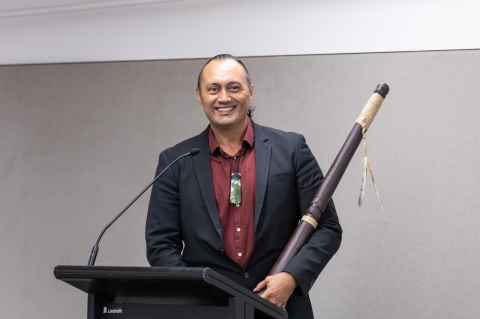
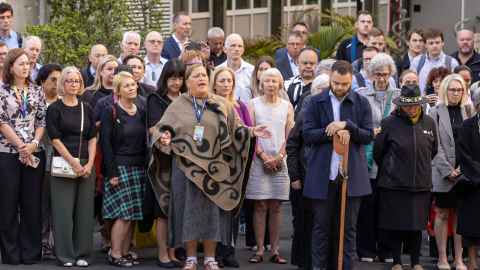
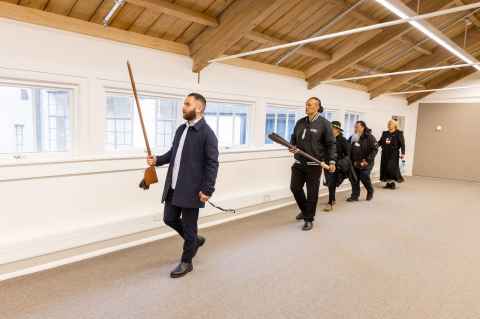
Michael Steedman, the University’s Kaiāratiki, opened the ceremony as he had for the building’s blessing with Ngāti Whatua Ōrākei on 1 December.
"The music never stops,” he said at the blessing. “And in a place that was intended for such things, it’s good to keep that in mind as we re-enter this space ... the work that was done by Ngāti Whātua, our ancestors and your ancestors as well.”
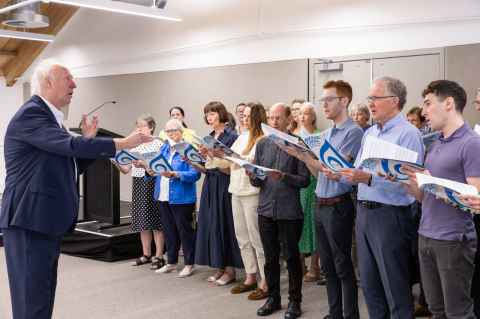
That music peeled out again at the opening with the Auckland Choral Society, who sang 'Blessing', a piece composed by School of Music alumnus and former staff member David Hamilton, an internationally renowned composer. Hamilton, who was part of the choir and is its president, performed under music director and conductor, Emeritus Professor Uwe Grodd.
As for concerns about pigeons roosting and messing up the newly painted portico, a discreet bird-deterrent system has been installed. If it works, it will indeed, like much else in this restoration, be a feat of genius.
Images of the blessing on 1 December below






The Auckland Choral Society sang 'Blessing', a piece composed by School of Music alumnus David Hamilton, an internationally renowned composer. Hamilton, who was part of the choir, performed under music director and conductor, Emeritus Professor Uwe Grodd.
Media enquiries: mediateam@auckland.ac.nz