Thirty years of transforming Māori enterprise
27 February 2026
Alumni have returned to celebrate 30 years of a programme that has propelled Māori into CEO, chair and senior leadership roles across Aotearoa, with a refreshed version now on the way.

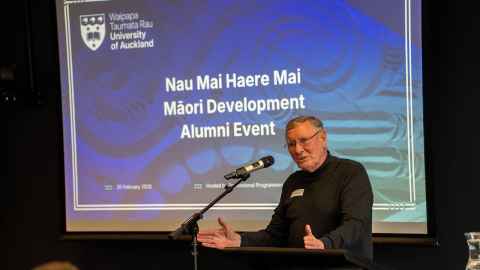
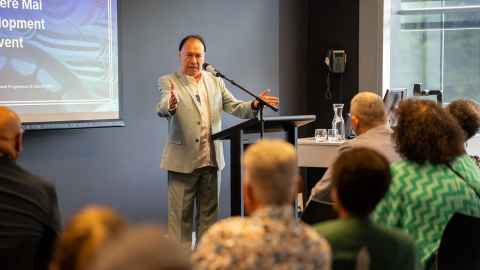
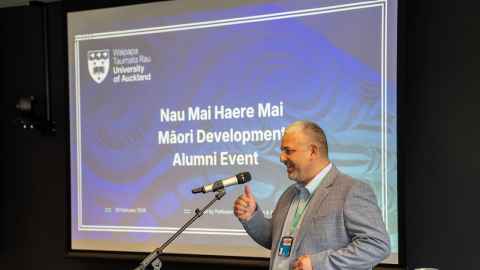
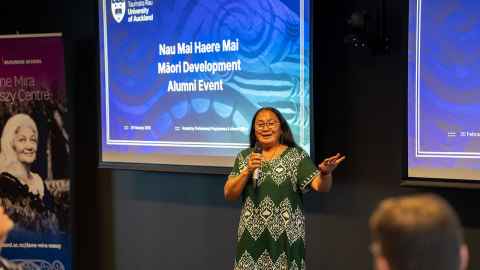
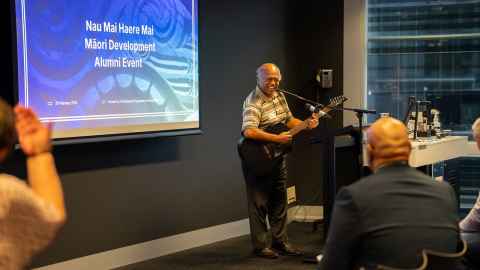
Alumni, staff and researchers of the Postgraduate Diploma in Māori Development gathered at the University of Auckland Business School in February to celebrate a programme many credit with reshaping not only their careers, but their confidence and leadership mindset.
Following in the footsteps of former, long-serving programme director, the late Associate Professor Mānuka Hēnare, and most recent director, Dr Kiri Dell, Professor Jason Mika said the evening was more than a reunion.
“It is a celebration and recognition of a programme that has consistently cast its net wider, reaching into communities, building bridges across regions and nurturing leaders whose work continues to transform Māori development in Aotearoa.
It was also an important acknowledgement of those leaders, Māori and Pākehā, whose vision, determination and generosity helped make the programme possible.
“And yet, Māori Development still has so much more to give,” he says.
Graduate School of Management director Andrew Eberhard welcomed guests with the whakataukī: ahakoa he iti, he pounamu – though small, it is precious, noting the Business School’s commitment to nurturing this pounamu for future generations.
A programme that changed mindsets
Te Tohu Huanga Māori, established in 1991, was the Business School’s first dedicated Māori-focused programme – and the first of its kind nationally.
Grounded in Māori knowledge systems and designed for working professionals, it sought to advance business excellence while expanding equitable access to advanced tertiary education.
Retired AUT professor of Māori Business, Dr Ella Henry, who was a pioneer of the programme, reflected on 1991, when she was asked what Māori might want from a business leadership qualification. After consulting esteemed Māori leaders, she presented her proposal to senior academics, a pivotal step in the creation of Te Tohu Huanga Māori.
She was backed by graduate and executive programmes leader Marty Perkinson, the programme moved quickly into design and recruitment. Among the early tauira was Dr Robert Pouwhare who said he had anxiety about studying business, but it turned into a defining moment in his career.
For many graduates and alumni of the programme, the impact was immediate.
Witere Williams (Tapuika, Waitaha, Tuhourangi, Ngāti Rangiwewehi) said the shift came within weeks of starting the course.
“Typically, we thought you get your degree and then your life changes. But Pāpā Mānuka changed our mindset immediately.”
Within three months Williams had three job offers and, within a year, was chair of Tapuika Iwi Authority. Now, he serves as an Operations Manager for Ruapōtaka Marae.
Teresa Tepania-Ashton MNZM (Ngāti Kahu ki Whangaroa, Ngāpuhi) described the experience as transformational.
“The programme is really about being able to work among our people confidently … to understand what needs to happen in order to make a difference.”
She went on to serve as CEO of Te Rūnanga-ā-Iwi o Ngāpuhi and later led Māori Women’s Development Incorporated. This year, she was appointed CEO of YWCA Tāmaki Makaurau.
“When I recruit, I look for this qualification. There’s real credibility in this programme.”
For Karleen Everitt (Ngāpuhi, Te Aupōuri), recipient of the 2024 Dame Mira Szászy Award, enrolling was about driving change for her hapū in Muriwhenua.
Her studies equipped her to help advance the long-running Muriwhenua Treaty claim in the far north. Now Head of Te Ao Māori Strategy at ANZ and founder of Manaaki Solutions Ltd, she said the programme opened doors.
“I set up my company, inspired by the opportunities that the University had presented to us.”

Building a national footprint
Much of the programme’s expansion is credited to Mānuka Hēnare, who became academic coordinator in 1996 and led the programme until 2014.
Under his leadership, lecturers were coordinated across eight departments to create a strong interdisciplinary foundation. The programme expanded beyond Auckland in response to Māori communities calling for equitable access to higher education.
In Te Tai Tokerau, a campus was established in Kawakawa in partnership with Ngāti Hine Hauora Whānui. Using a block teaching model, students travelled from across the North every second Saturday, while university lecturers travelled north in return.
Later, partnership with the University of Auckland’s Whangārei Campus enabled online study between Auckland and Northland. Today, Northland classes are held at the Treaty of Waitangi Centre in the Bay of Islands.
Rotorua followed in 2004 through a memorandum of understanding with Crown Research Institute Scion, where one of the country’s most advanced teaching facilities at the time supported Huanga Māori masters-level learning.
Looking ahead
Over three decades, Te Tohu Huanga Māori has continually refined its teaching through engagement with alumni and Māori leaders across iwi, business and government.
Its purpose remains to prepare leaders of strong Māori enterprises and contribute to a thriving Māori economy grounded in mana.
A refreshed version of the programme is now in development, designed to meet the evolving needs of Māori leaders and enterprises.



Media contact
Te Rina Ruka-Triponel
E: te.rina.triponel@auckland.ac.nz