Keeping calm and carrying on: Faith Culas wins 3MT
20 July 2026
From microscopic ocean life to children's eye health, 13 doctoral candidates captivated the audience at the University of Auckland's Three Minute Thesis Final, where Faith Culas kept her cool to claim the top prize.

As Friday evening rolled around and people were switching their attention to the weekend and Semester Two ahead, 13 University of Auckland doctoral candidates were showcasing their smarts for the Three Minute Thesis (3MT) Final. In just 180 seconds each, they were challenged to excite a packed-out lecture hall about their research in a way that would inform, surprise and inspire.
If you arrived early, you’d have witnessed the vibe from the contestants’ first vocal warm-ups, a collegial huddle of the competitors culminating in a nerve-calming wa-hoo!
Over the next couple of hours, the audience and judges heard about the hidden identity struggles faced by young adults living with autoimmune disease; microscopic zooplankton; how virtual reality might foster intercultural understanding; and how medieval church courts dealt with repeat adulterers.
The finalists represented faculties and disciplines from across the University, and their speeches were ranked by the judging panel: Dame Professor Juliet Gerrard, Gilbert Wong (Research Communications) and last year’s 3MT runner-up, Rebecca O’Leary.
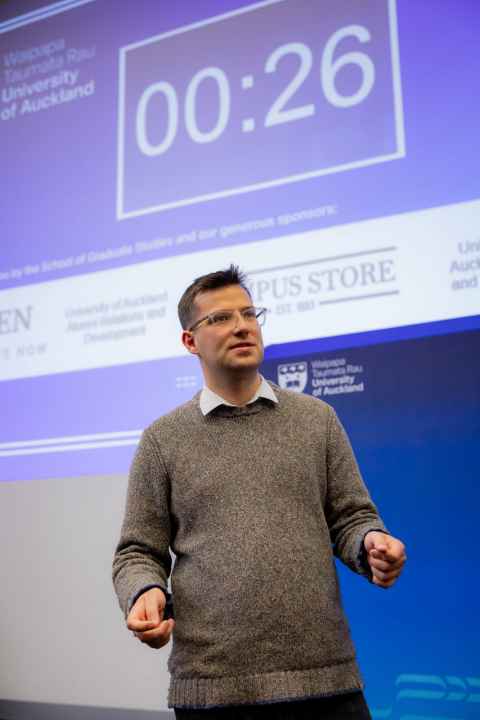
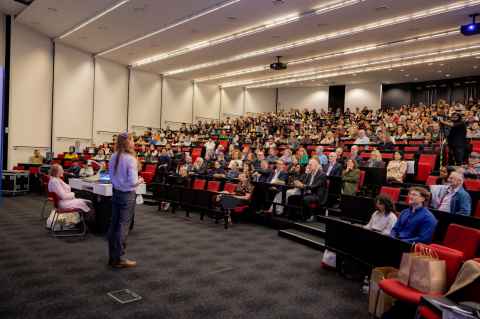
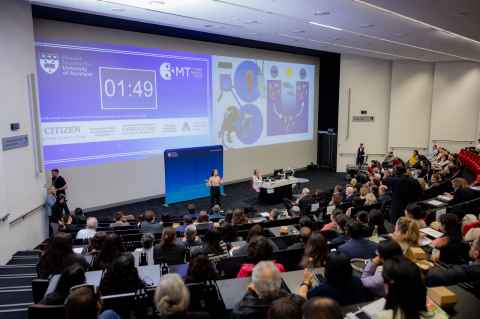

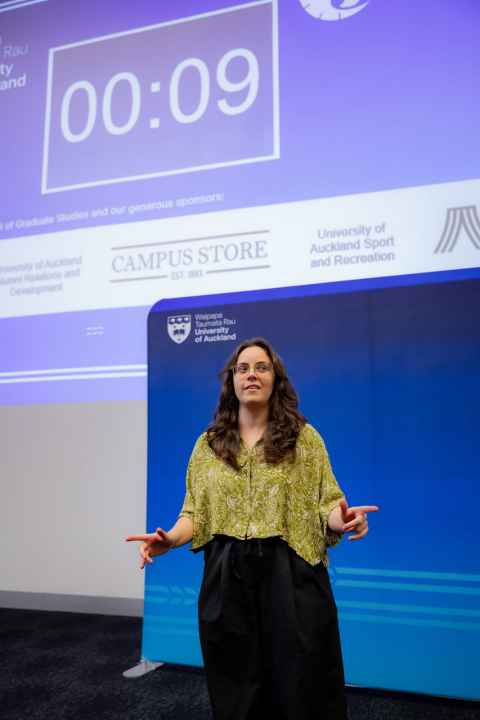
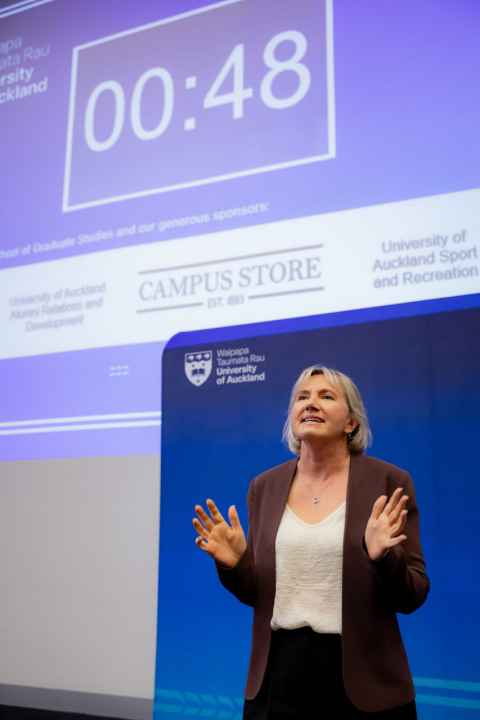


Showing no sign of nerves, first up was Nikki Singh (Medical and Health Sciences) whose presentation was grounded in both research and lived experience. Exploring the impact of autoimmune disease on identity, she challenged people to look beyond symptoms and treatment, arguing that how people understand themselves can be just as important to health outcomes as clinical care.
Andreia Valente (Auckland Bioengineering Institute) discussed her research into the future of "engineering emotions". Using technology that can influence how people perceive signals from their own bodies, her research explores new possibilities for supporting mental health, trauma recovery and emotional well-being. Was her research helping keep her heart-rate down while presenting?
Arts and Education competitor Nicholas Ringwood transported the audience to 14th-century England, revealing how medieval church court records provide remarkably detailed insights into ordinary lives, relationships and scandals, while uncovering patterns of repeat offending that have remained largely overlooked by historians. The former lawyer is examining 1,000 cases, most involving the sins (treated as crimes) of ‘fornication’ (sex outside marriage) and adultery.
Marine ecologist Emma McGuigan (Science) had told the organisers previously that public speaking was her greatest fear. It didn’t show as she energetically described some of the ocean's smallest inhabitants. Her presentation highlighted the critical role zooplankton play in sustaining marine ecosystems around the remote Rangitāhua Kermadec Islands, despite their often-invisible presence.
Representing the Business School, Vickie Mingxia Ma drew on a holiday experience to investigate how consumers use multiple devices when shopping online. Her research challenges the assumption that devices compete with one another, suggesting instead that they work together to help people complete different tasks.
Natural hazards researcher Dan Bain (Engineering and Design) brought a distinctly New Zealand focus, examining how landslides affect roads, communities and even holidays. His work aims to improve predictions of disruption and isolation during future severe weather events and earthquakes.
Sachi Rathod (Medical and Health Sciences) combined personal experience with professional expertise in her presentation on children's eye health. Her optometry research investigates how more accessible screening and treatment could help prevent thousands of children from falling through gaps in the current system.
Helen Zipei Liu (Arts and Education) explored how virtual reality could help children develop intercultural understanding. Drawing on her background as an educator, she demonstrated how immersive technology can help young people engage with cultures beyond their own and develop a greater sense of global citizenship. Unfortunately, Helen heard the dreaded time-out buzzer.
Science finalist Jozie Sharpe focused on the often-overlooked transition to motherhood. Her research, drawing on neuroscience, examines maternal self-efficacy and how supportive environments can help new mothers build confidence at a time of significant personal change. Did you know that new mothers' brains rewire to help them attune to their babies, but that change also makes the transition to motherhood more susceptible to stress?
Auckland Bioengineering Institute researcher Robin Milward Cooney looked to nature for inspiration, developing artificial muscles that could one day power underwater robots in a more natural way than occurs now. His work seeks to create machines that move more like marine animals and less like conventional propeller-driven vehicles.
Dalia Kadow (Liggins Institute), who has only been in New Zealand since May, highlighted the importance of trust, partnership and cultural understanding in health research, with a presentation titled ‘Kawakawa, tikanga and trust’. Working alongside Māori communities and practitioners of rongoā Māori, her research explores how future health studies can be shaped through meaningful collaboration from the outset.
Faith Culas (Engineering and Design) turned the spotlight on diversity in software engineering, investigating how different people approach problem-solving and how the design of digital tools can unintentionally favour certain ways of thinking over others.
Around half-way through her presentation, the microphone and all AV cut out. Did she stop? No, she did not. She barely batted an eyelid, continuing her presentation as if she’d designed her own ‘keep calm and carry on’ software.

The final presentation came from Ross Miller, who timed out in last year’s competition going over the buzzer by two seconds but still earning People’s Choice. He returned describing it as “unfinished business” to talk about developing a writing system for sign language. His work aims to improve literacy opportunities for Deaf communities by enabling people to read and write in their own language. He tested the heart rates of the audience again as he moved away from where he could be reminded of the time with the 30-second and ten-second flags, to gesticulate animatedly at his drawings on the screen… just squeaking in under the three-minute mark.
Then, popcorn and chocolate consumed by the animated and supportive crowd, including many PhD supervisors and Deans, it was time for Pro Vice-Chancellor Global and Graduate Research Professor J R Rowland to fill in time and thank the contestants while the judges undertook their difficult task: "Tonight we saw not only outstanding research, but people sharing something of their genuine selves,” Rowland said. “Every doctoral candidate enriches our university, our city and our country, and together they create the diversity of thought, curiosity and discovery that makes a research-intensive university thrive."

And who were the winners?
Runner Up - Sachi Rathod
Sachi moved to New Zealand from India, aged ten. On screen for her simple slide was an image of a blurry classroom, reflecting what she herself experienced as a child and which led her down her current research path. She pointed out how vital it was that eyesight testing occurs more often than just Year 1 and Year 7 at school. “By the year 2050, half of the world population is predicted to be short-sighted. With my research, we could build better eye care policy - a pathway woven in from preschools through to high schools.”
People’s Choice - Emma McGuigan
For someone who claims not to like public speaking, it seems like she was in fact made for it, nailing her presentation on ‘Uncovering the ocean’s hidden heroes’. She also probably won ‘loudest cheerleaders’.
Winner - The unflappable Faith Culas
Her presentation was already top class, and the fact that she didn’t miss a beat when the AV equipment failed was next level. A software engineer and early-career researcher, Faith compared the highly relatable simple slide showing a couple assembling IKEA furniture, one reading the manual, the other taking his chances with what goes where, with how there is often limited diversity in decision making when it comes to software.
Her goal is to make a positive difference through technology by creating tools that support the different ways people think. Faith, who began her career in telecommunications software development in her homeland Sri Lanka, is already working with the Centre for Innovation and Entrepreneurship in its Hatchery on her ideas.

About 3MT
The Three Minute Thesis (3MT) is an academic research communication competition held by more than 900 universities from 85 countries.
Doctoral candidates share the story of their research with a general audience in under three minutes, supported by only a single, static slide. All currently enrolled doctoral candidates are eligible to compete in the competition.
The School of Graduate Studies (SGS) runs the University’s competition with faculty heats in June and the final in July. The winner of the University of Auckland 3MT Final goes on to represent the University internationally in the Asia-Pacific Virtual 3MT Competition and the U21 Virtual 3MT Competition.
View all the 2026 3MT performances.
Media contact:
Media adviser | Jogai Bhatt
M: 027 285 9464
E: jogai.bhatt@auckland.ac.nz