More Pacific women needed in leadership roles
29 March 2026
Education and collective responsibility are important to support more Pacific women into leadership.

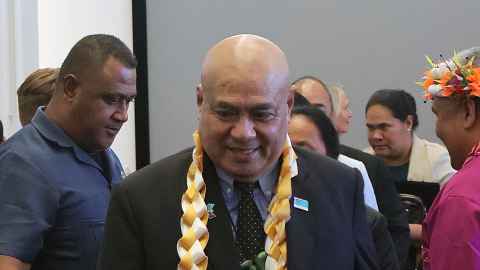
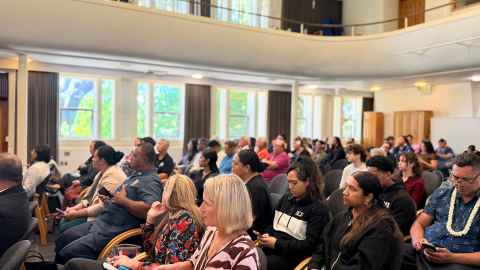
The University of Auckland hosted Tuvaluan Prime Minister Hon. Feleti Penitala Teo OBE on Friday 27 March, for a high level Pacific talanoa examining leadership, sport and shifting gender norms across the region.
'Leadership, sport and shifting gender norms: a Pacific talanoa' brought together Pacific political, sporting and academic leaders to explore how sport shapes social behaviour, expectations and leadership - and how inclusive leadership can strengthen gender equality, community resilience and regional stability across the Blue Pacific.
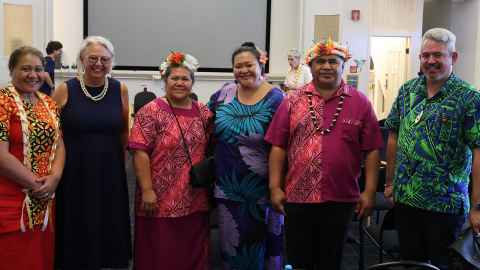
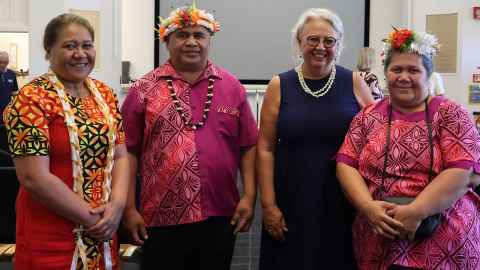
Prime Minister Teo, a recognised regional advocate for gender equality and respectful leadership, joined prominent New Zealand sporting figures including University of Auckland alumni La‘auli Sir Michael Jones, Kava‘onau ‘o Tapulululu Caroline S. Fanamanu, and New Zealand Olympic Committee President Liz Dawson.
The discussion was facilitated by Pro Vice-Chancellor Pacific Professor Jemaima Tiatia Siau, alongside Professor of Pacific Studies Professor Yvonne Underhill Sem.
Opening the talanoa, Prime Minister Teo thanked the University for creating space for difficult but necessary conversations.
“I speak with a lot of passion about gender equality,” Prime Minister Teo said. “Affording and promoting gender equality is where we see a lot of work still needs to be done - and a major factor slowing progress is the norms and practices we are accustomed to.”
Speaking candidly about Tuvalu’s political realities, he reflected on the structural and cultural barriers facing women in leadership.
“In the 47 years since Tuvalu became independent, there have only been three women ever elected to our Parliament,” he said. “Our current Parliament has no women members. That track record tells us very clearly we still have a lot of work to do.”
Prime Minister Teo noted that deeply rooted social expectations, often shared by both men and women, continue to limit women’s leadership opportunities.
“These norms, what I regard as ‘expected’, are unfortunately not only male perceptions. They are often shared widely within the women’s population as well, that women do not have a place in leadership,” he said. “That is why education and collective responsibility are so important.”
Affording and promoting gender equality is where we see a lot of work still needs to be done - and a major factor slowing progress is the norms and practices we are accustomed to.

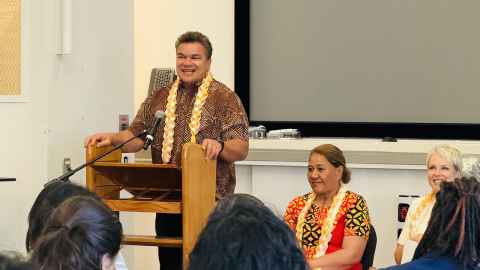


Professor Jemaima Tiatia-Siau said the talanoa reflects growing recognition of sport as a powerful site of social leadership in Pacific communities.
“Sport is one of the most influential spaces in Pacific societies for shaping values, relationships and leadership,” Professor Tiatia-Siau said. “This talanoa creates space for honest, culturally grounded conversation about how gender norms are formed, challenged and transformed - and how leaders at every level can model respect, inclusion and care.”
The discussion highlighted how women’s visibility and leadership in sport can advance gender equality, and how men and boys can actively support women's and girls’ rights by normalising their full participation. It also examined the responsibility of coaches, teams, clubs and governance bodies in challenging harmful norms and preventing violence.
Professor Yvonne Underhill-Sem said the talanoa comes at a critical moment for the region.
“Across the Blue Pacific, questions of leadership, safety and social cohesion are deeply connected,” Professor Underhill-Sem said. “Tuvalu has been very clear that addressing the deeply rooted challenge of gender based violence is central to peace and stability in our region.”
She referenced Prime Minister Teo’s leadership at regional and global forums, including his statements linked to the 2025 Pacific Declaration on Oceans of Peace.
“Prime Minister Teo has reminded us that we cannot expect peace in our region while there is violence in our homes and villages,” she said. “Sport is a shared cultural space where transformation can happen for individuals, families, communities and nations.”
Prime Minister Teo also reflected on lessons shared by Pacific women leaders, recalling his participation alongside former Sāmoan Prime Minister Fiamē Naomi Mata‘afa at the Commonwealth Heads of Government Meeting in Apia in 2024.
“One thing Prime Minister Fiamē said has stayed with me,” he told the audience. “‘You just have to show up. You can’t sit around and expect leadership to come to you - you have to own it and be confident.’ That message matters across the Pacific.”
The event supports regional momentum ahead of the upcoming Pacific Islands Forum Leaders’ Meetings and reflects shared Pacific commitments to gender equality, positive social norms and safer, more resilient communities.
The talanoa was proudly co-hosted by the University of Auckland’s Office of the Pro Vice-Chancellor Pacific and Pacific Studies department, together with New Zealand’s Ministry of Foreign Affairs and Trade (MFAT).