Introduction to research integrity and good research practice
Learn more about 'Research integrity', 'good research practice (GRP)' and 'responsible conduct of research (RCR)', and how to apply the research integrity principles throughout your research.
What is research integrity?
Research integrity is also referred to as ‘good research practice (GRP)’ or ‘responsible conduct of research (RCR)' and encompasses the types of attitudes and behaviours that promote trust and confidence in research.
The Singapore Statement (2010) was formulated through global collaborations at the second World Conferences on Research Integrity (WCRI) and was the first attempt to establish a common set of global values and principles for good research practice.
These principles have since been incorporated into national codes (e.g. the Australian Code for the Responsible Conduct of Research (2018), the UK Research Integrity Office (UKRIO) Code of Practice for Research (2023)) and regional codes (e.g. APEC Guiding Principles for Research (2022), and the European Code of Conduct for Research Integrity (2023)). The Research Charter for Aotearoa New Zealand was published in 2020.
These codes share common values and expectations and share the common structural feature that the research integrity responsibilities of host research organisations and researchers (staff and research students) are clearly demarcated for different activities across the research lifecycle.
The Singapore Statement (2010) contains four principles with two further principles added at the WCRI Hong Kong conference in 2019.
Principles:
- Honesty - in all aspects of research work
- Accountability - in the conduct of research
- Professional courtesy and fairness – in working with others
- Good stewardship – on behalf of others
- Transparency – of the research process and presentation of results
- Clarity - communication to be understandable, explainable and accessible
Why is research integrity important?
The credibility of research findings that supports the advancement of scientific knowledge is the most important building block for promoting trust and confidence in research.
In addition, good research practice ensures that studies are conducted with honesty, accuracy, and objectivity, leading to better study designs, improved techniques, and reliable data and prevents wastage of time, resources, and funding.
Retaining the trust of the public, who, as taxpayers, contribute to Government funding for research, is another important reason to ensure research is conducted with integrity and the highest ethical standards.
Integrity across the research lifecycle
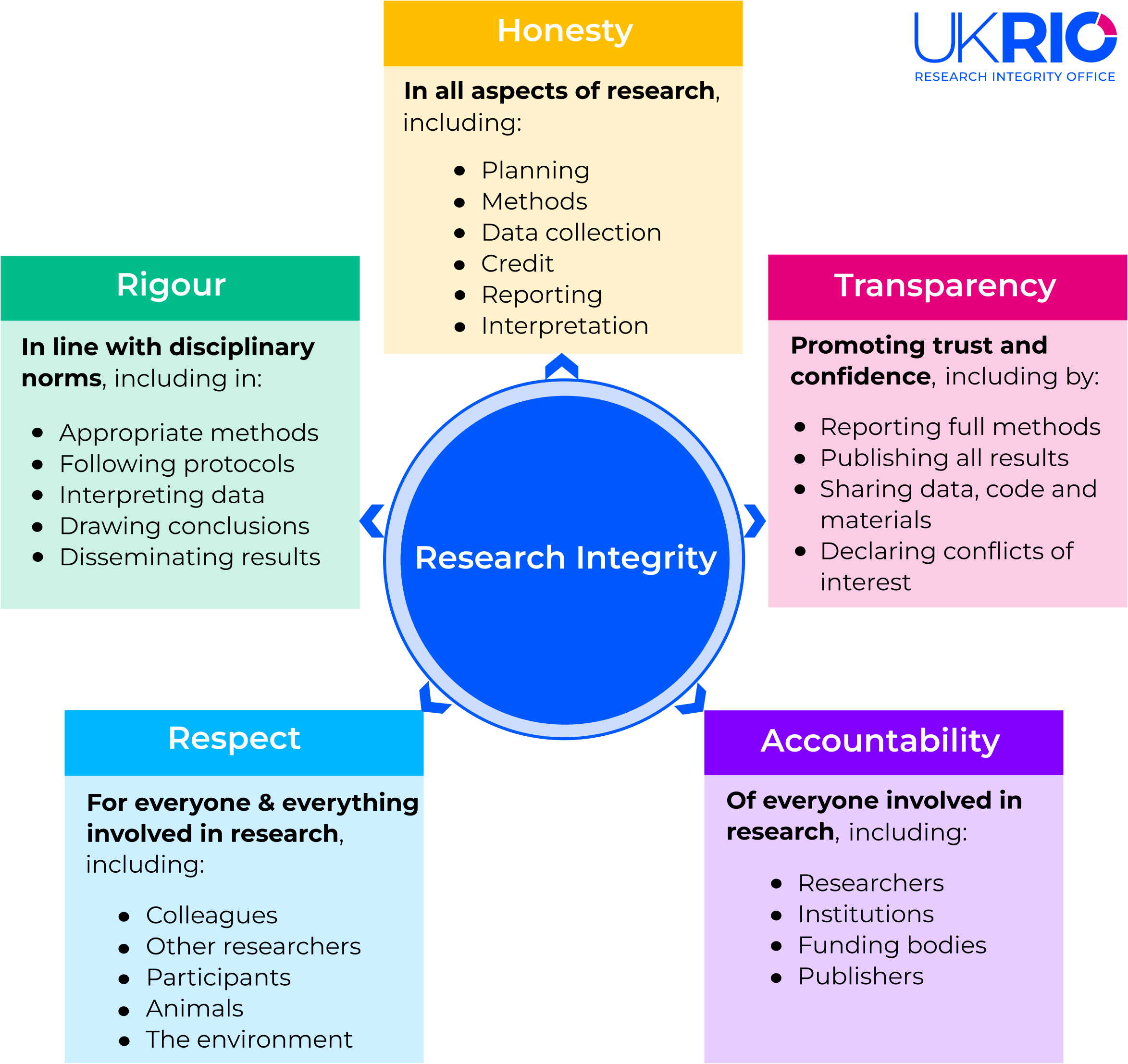
The research lifecycle describes the process of discovery from end to end, and each step encompasses activities that embody research integrity. The research activities listed below are grounded on the widely accepted research integrity principles.
Honesty
In all aspects of research, including:
- Planning
- Methods
- Data collection
- Credit
- Reporting
- Interpretation
Rigour
In line with disciplinary norms, including in:
- Appropriate methods
- Following protocols
- Interpreting data
- Drawing conclusions
- Disseminating results
Transparency
Promoting trust and confidence, including by:
- Reporting full methods
- Publishing all results
- Sharing data, code and materials
- Declaring conflicts of interest
Respect
For everyone and everything involved in research, including:
- Colleagues
- Other researchers
- Participants
- Animals
- The environment
Accountability
Of everyone involved in research, including:
- Researchers
- Institutions
- Funding bodies
- Publishers
From the UK Research Integrity Office (UKRIO) "What is Research Integrity?"
Contact
Research Integrity Officer
Email: Dr Elizabeth Visser